American Latina
 Brazil
 Czech
 Finnish
 France
 Germany
 Italy
 Norway
 North America
 Polish
 Portugal
 South Africa
 Swedish
 Spanish
 United Kingdom


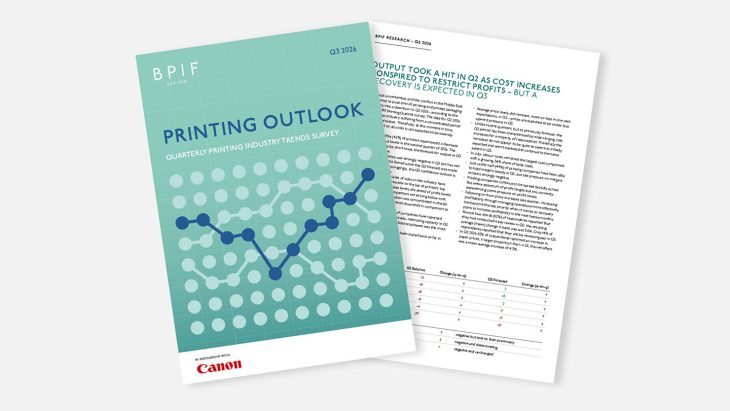
Output took a hit in Q2 as cost increases conspired to restrict profits – but a recovery is expected in Q3.
Featured In Printing Outlook This Quarter:
- Output and orders – last quarter and forecast for this quarter.
- Business confidence, concerns, and uncertainty levels.
- Turnover – annual and monthly turnover analysis and forecasts.
- Capacity – utilisation and constraints.
- Costs – paper & board, ink, labour, energy, and average cost structure.
- Trend data on employment, prices, costs, margins, profits, cash flow and productivity.
- Profitability benchmarks and plans for improvement.
- Pay Reviews – activity and average % changes.
- International trade – export orders and price trends.
- Industry insolvency and financial health statistics.
- Consumables – paper consumption and printing ink data.
- Energy – sector update and comment.
Summary Of Key Findings:
- Over two-fifths (42%) of printers experienced a decrease in their output levels in the second quarter of 2026. The downturn may be short-lived, the forecast for output in Q3 is more positive.
- Industry confidence was strongly negative in Q2 but has not sunk to the depths feared when the Q2 forecast was made in April. More encouragingly, the Q3 confidence outlook is marginally positive.
- Concerns over the level of sales in the industry have increased to lead a reorder to the list of printers’ top business concerns. Sales levels sits ahead of profit levels, and the belief that competitors are pricing below cost.
- Industry capacity utilisation was concentrated in the 60-90% ranges in July, a general downshift in comparison to April.
- An increased proportion of companies have reported factors, other than order levels, restricting capacity in Q2. The shortage of suitable skilled employees was the most significant constraint.
- Recruitment intentions have been scaled back so far in 2026.
- Average price levels did increase, more-or-less in line with expectations, in Q2 – prices are expected to be under less upward pressure in Q3.
- Unlike recent quarters, but as previously forecast, the Q2 period has been characterised by wide-ranging cost increases for a majority of respondents. Thankfully the increases do not appear to be quite as severe as initially expected and aren’t expected to continue to the same extent in Q3.
- In July, labour costs remained the largest cost component with a growing 34% share of total costs.
- Just under half (49%) of printing companies have been able to hold margins steady in Q2, but the pressure on margins remains strongly negative.
- Printing companies continue to be spread broadly across the entire spectrum of profit ranges but are currently experiencing some pressure on profit levels.
- Following on from price increases last quarter, increasing profitability through managing operations more effectively has become the top priority when it comes to company plans to increase profitability in the next twelve months.
- Almost two-thirds (62%) of respondents reported that they had conducted a pay review in Q2. the resulting average (mean) change in basic pay was 3.6%. Only 14% of respondents reported that they will be reviewing pay in Q3.
- In Q2 2026 62% of respondents reported an increase in paper prices, a larger proportion than in Q1, the net effect was a mean average increase of 4.3%.
Kyle Jardine, BPIF Economist, said:
“Companies have referenced confidence being hit by uncertainty, leading to delays in purchasing decisions and investments. Most costs have increased by similar amounts in a short period of time – but not all have been passed on as price increases. Orders and output have taken a knock, but the industry is expecting some degree of recovery as we move into the second half of the year. Despite the future direction of Government policy still being unclear, and the lack of endgame certainty over conflicts in the Middle East and Ukraine – the industry is forecasting that Q2 will be the low point for 2026 and that confidence and activity levels will improve in Q3.”
Charles Jarrold, BPIF Chief Executive, said:
“Industry demand, profit levels, and concerns that some competitors are pricing below cost are the significant concerns being voiced by companies. Hopefully a pick-up in confidence, a fall in uncertainty, and an increase in demand in the second half of this year will go some way to allay these concerns. Of course, some other persistent and common gripes remain; lack of investment support, an increasing regulatory burden, more obstacles in trading with the EU, recruiting difficulties, damaging effects of minimum wage increases, and inconsistencies in business rates – to list a few. We do of course voice such concerns in our regular representations to Government; we’ll find out more about the direction the new Prime Minister will take in the next few weeks and months.”
Duncan Smith, Country Director, Production at Canon UK & Ireland, and sponsor of the printed Printing Outlook report, said:
“The print industry has always demonstrated a remarkable ability to adapt. Whether that’s responding to changing customer expectations, embracing new technologies or navigating economic uncertainty, businesses across our sector continue to show resilience, innovation and determination. As we move through 2026, organisations are balancing a wide range of priorities, from improving operational efficiency and investing in future growth, to meeting evolving sustainability commitments. The insight and guidance provided by BPIF continues to be an important resource for the industry, which helps businesses understand market trends, navigate challenges and make informed decisions with confidence.“